
This Bible study considers burial or cremation through biblical examples, resurrection hope, and Christian perspectives.
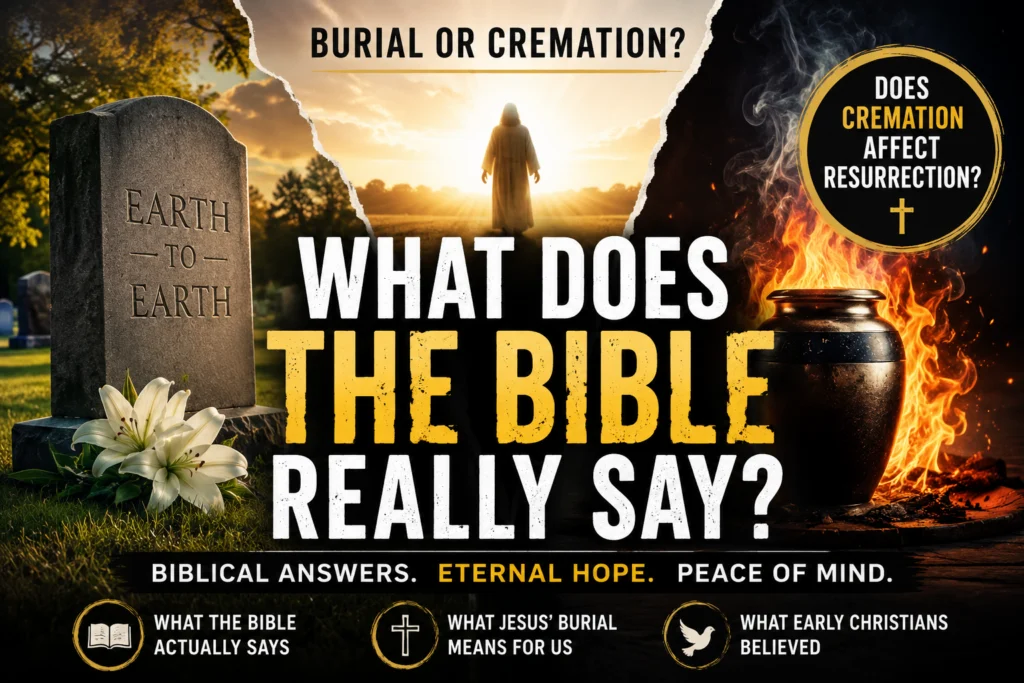
Table of Contents
Does Cremation Prevent Resurrection?
One of the most emotionally charged questions Christians face is whether a believer should be buried or cremated. Families often find themselves wrestling with tradition, finances, personal wishes, and biblical convictions during an already difficult time.
Some Christians strongly believe burial is the only biblical option. Others see cremation as an acceptable choice because God can resurrect the dead regardless of what happens to the physical body.
So what does the Bible actually say?
The answer is simpler than many realize: Scripture provides numerous examples of burial, but nowhere commands burial and nowhere forbids cremation. The Christian hope is ultimately found not in the condition of the body after death, but in the power of God to raise the dead through Jesus Christ.
Death forces every believer to consider eternity with questions such as:
- Does God prefer burial?
- Is cremation a sin?
- Did Jesus establish burial as the Christian model?
- Will cremation affect the resurrection?
- What did the early church believe?
- What do some Christian denominations teach today?
These are important questions, and they deserve answers based on Scripture rather than assumptions or traditions.
What the Bible Says About Burial
Burial was the common practice among God’s people. Throughout both the Old and New Testaments, burial was the normal method used for God’s people.
Abraham Buried Sarah
After Sarah died, Abraham purchased a burial place.
“And after this, Abraham buried Sarah his wife in the cave of the field of Machpelah.”
— Genesis 23:19 (KJV)
Jacob Requested Burial
Before his death, Jacob instructed his family to bury him with his fathers.
“Bury me with my fathers.”
— Genesis 49:29 (ESV)
Joseph Desired Burial
Joseph’s final request was that his bones be carried to the Promised Land.
“God will surely visit you, and ye shall carry up my bones from hence.”
— Genesis 50:25 (KJV)
Jesus Was Buried
The most significant burial recorded in Scripture is that of Jesus Christ.
“And laid it in his own new tomb.”
— Matthew 27:60 (NKJV)
The Apostle Paul includes Christ’s burial as part of the Gospel itself.
“That Christ died for our sins according to the scriptures; And that he was buried, and that he rose again the third day according to the scriptures.”
— 1 Corinthians 15:3-4 (KJV)
Because Jesus was buried and later raised, many Christians view burial as a powerful picture of resurrection hope.
Burial Was Often Considered an Honor
Throughout the Old Testament, receiving a proper burial was generally viewed as a blessing.
“He was buried in the city of David among the kings.”
— 2 Chronicles 32:33 (ESV)
Likewise, being denied burial was sometimes portrayed as a form of judgment.
“They shall not be lamented, neither shall they be buried.”
— Jeremiah 16:6 (KJV)
However, these passages describe historical circumstances rather than universal commands regarding funeral practices.
What the Bible Says About Cremation
Many people are surprised to discover that the Bible never directly condemns cremation. There is no verse that says:
- Christians must be buried.
- Cremation is sinful.
- Cremation prevents resurrection.
- A believer who is cremated dishonors God.
Such commands simply do not appear anywhere in Scripture.
Instances of Burning Bodies in Scripture
Saul and His Sons
After Saul and his sons were killed in battle, their bodies were recovered by the men of Jabesh-Gilead.
“And they took their bones, and buried them under a tree at Jabesh.”
— 1 Samuel 31:13 (KJV)
Prior to burial, the bodies were burned (1 Samuel 31:12).
Many scholars believe this was done because the bodies had been mutilated by the Philistines and were in poor condition. The passage neither commands nor condemns cremation.
Amos 6:10
Another passage references burning the dead:
“And a man’s uncle shall take him up, and he that burneth him…”
— Amos 6:10 (KJV)
Again, the text is descriptive rather than instructional.
Does the Bible Command Burial?
No. While burial is overwhelmingly the biblical pattern, Scripture never commands Christians to bury their dead. This distinction is important. Christians should be careful not to create doctrines where God has not spoken. The Bible records many examples of burial, but examples are not always commands.
Does the Bible Forbid Cremation?
No. After examining the whole counsel of Scripture, there is no biblical prohibition against cremation. No prophet condemns it. No apostle forbids it. No New Testament teaching declares it sinful. For that reason, many evangelical theologians conclude that cremation falls within the realm of Christian liberty.
The Most Important Question: Does Cremation Affect the Resurrection?
The biblical answer is an emphatic no. The resurrection depends upon God’s power—not the preservation of a corpse. Throughout history, countless believers have died under circumstances where no intact body remained. Some were:
- Lost at sea
- Burned in fires
- Martyred
- Eaten by animals
- Destroyed in wars
- Reduced to dust through centuries of decay
Yet Scripture never suggests these believers will somehow miss the resurrection.
God Can Raise the Dead
Jesus declared:
“With God all things are possible.”
— Matthew 19:26 (NIV)
If God created Adam from the dust of the earth, He can certainly recreate a glorified body from ashes.
Paul's Teaching About the Resurrection Body
Paul explains:
“So will it be with the resurrection of the dead. The body that is sown is perishable, it is raised imperishable.”
— 1 Corinthians 15:42 (NIV)
The emphasis is not preservation but transformation. Paul compares burial to planting a seed.
“What you sow does not come to life unless it dies.”
— 1 Corinthians 15:36 (NIV)
Whether a body decomposes naturally or is cremated, God remains fully capable of raising it.
Ezekiel's Valley of Dry Bones
One of the most powerful pictures of resurrection appears in Ezekiel 37. God showed Ezekiel a valley filled with dry bones.
“I will put breath in you, and you will come to life.”
— Ezekiel 37:6 (NIV)
The vision demonstrates God’s power to restore life where no human possibility remains.
What Happens to the Body at the Resurrection?
Christians believe that one day Jesus Christ will return.
At that time:
- The dead in Christ will be raised.
- Believers will receive glorified bodies.
- Death will be defeated forever.
Paul writes:
“For this corruptible must put on incorruption, and this mortal must put on immortality.”
— 1 Corinthians 15:53 (KJV)
The resurrection body will be:
- Imperishable
- Glorious
- Powerful
- Spiritual
- Eternal
The future body is not merely a repaired earthly body but a transformed and glorified one.
What Did the Early Church Believe?
Historical evidence shows that early Christians overwhelmingly preferred burial. One reason was theological.
Burial reflected:
- Christ’s burial
- Future bodily resurrection
- Respect for the body as God’s creation
Archaeological evidence from Christian catacombs demonstrates widespread burial practices among early believers. Historians note that burial became one of the identifying customs of Christians in contrast to many pagan Roman practices during portions of the Roman era. However, the historical preference for burial should not be confused with a biblical command.
Roman Catholic Teaching
The Catholic Church strongly prefers burial but permits cremation. The Vatican’s instruction Ad resurgendum cum Christo states that the Church continues to prefer burial because it more clearly expresses Christian hope in bodily resurrection. At the same time, the Church teaches that cremation does not prevent resurrection and is not prohibited unless chosen as a rejection of Christian doctrine.
Eastern Orthodox Teaching
The Eastern Orthodox Church traditionally favors burial and generally discourages cremation.
Orthodox Christians typically view burial as more consistent with historic Christian practice and the symbolism of awaiting bodily resurrection.
Protestant Teaching
Most Protestant denominations permit either burial or cremation. Among Baptists, Methodists, Lutherans, Presbyterians, Pentecostals, and many non-denominational churches, the focus is generally placed upon faith in Christ rather than the specific disposition of earthly remains. The common Protestant position is that God’s resurrection power is not limited by cremation.
Why Some Christians Choose Burial
Many believers prefer burial because:
- It follows the predominant biblical pattern.
- Jesus was buried.
- It symbolizes resurrection hope.
- It reflects historic Christian tradition.
- It provides a physical location for remembrance.
Why Some Christians Choose Cremation
Other believers choose cremation because:
- Scripture does not forbid it.
- God can resurrect ashes as easily as dust.
- It is often less expensive.
- Family circumstances may make burial difficult.
- They view the decision as a matter of personal conviction.
Romans 14 offers an important principle:
“Each of them should be fully convinced in their own mind.”
— Romans 14:5 (NIV)
The Real Issue Is Not Burial or Cremation
The Bible’s primary concern is not what happens to the body after death. Its primary concern is whether a person knows Jesus Christ.
Jesus said:
“I am the resurrection and the life. He that believeth in me, though he were dead, yet shall he live.”
— John 11:25 (KJV)
A cemetery cannot save anyone. An urn cannot save anyone. Only Christ saves.
Final Conclusion
After examining Scripture, history, and Christian doctrine, several conclusions emerge.
The Bible Clearly Teaches
✓ Burial was the normal biblical practice.
✓ Jesus was buried.
✓ Believers will experience bodily resurrection.
✓ God has power over death.
The Bible Does Not Teach
✗ Cremation is a sin.
✗ Cremation prevents resurrection.
✗ Christians are required to be buried.
✗ Salvation depends upon funeral arrangements.
For this reason, sincere Christians may arrive at different conclusions. Some will choose burial because it follows the biblical pattern and historic Christian tradition. Others will choose cremation because Scripture does not prohibit it and because they trust fully in God’s power to raise the dead. The ultimate Christian hope is not found in a grave or an urn.
It is found in Jesus Christ.
“For the Lord himself shall descend from heaven with a shout… and the dead in Christ shall rise first.”
— 1 Thessalonians 4:16 (KJV)
Whether buried, cremated, lost at sea, or reduced to dust, every believer’s future rests securely in the hands of Almighty God.
What are your thoughts? Do you agree or not? Let’s discuss!
About the author and founder of AlaskaByte Ministry:
Scott has been on a journey that has changed his life forever. Having been in a horrific incident where he was severely burned, it changed his entire outlook on life. From the many years he served his community, to the outreach he is doing today, he continues to be a servant. Not of just his fellow man, but a servant of God. You can get more information about Scott in the “About” section of this website.
About AlaskaByte Ministry
AlaskaByte Ministry exists to proclaim the Gospel of Jesus Christ and share the hope of eternity through biblical teaching, personal testimony, and encouragement from God’s Word. Founded after a remarkable journey through life-threatening medical crises and a powerful encounter that transformed a life forever, AlaskaByte Ministry seeks to point people to Jesus Christ—the only true source of salvation, hope, and eternal life.If you have never trusted Jesus Christ as your Lord and Savior, today can be the day your eternity changes forever.
Find related topics in the Bible Studies hub.
Read the Scripture in context
Read Paul’s discussion of the resurrection in 1 Corinthians 15, then return to the article and consider the author’s reflections.
Share your Christian story
Create a free account to share testimonies, prayer requests, and other Christian stories, or to join the comments. Already registered? Sign in, then create a post. You can also explore the testimony archive and community prayer requests.
You can also watch the ministry’s official YouTube channel for Christian videos and encouragement.